Bangata Knowledge Connectors: Six Predictions Tested, Five Student Voices, and What Happened After the Connections
Final Fieldwork Report | Bangata Village, Arusha DC | August 2026
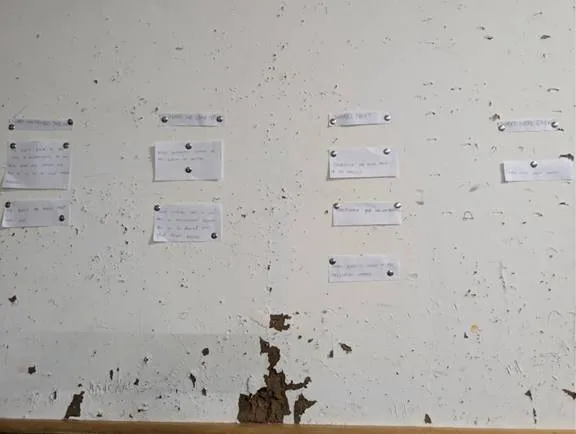
The students’ retrospective board: what happened, what they learnt, what comes next, and where they were stuck.
What happened after a line was drawn on a community knowledge map?
For the five Bangata Knowledge Connectors from Sakura Girls Secondary School, that became the defining question of their final fieldwork week in Bangata Village, Arusha DC.
By Week 3, the students had interviewed 12 respondents, selected six people for their connection map, documented why others were not selected, and written six predictions about what might happen when people with relevant knowledge, experience or needs were connected.
In Week 4, they went back. Their task was no longer to ask what might happen. It was to find out what did happen. Fieldwork closed on 24 August 2026.
The students report that the people involved in the six mapped connections met and shared their experiences. During follow-up, participants reported that the expected problems identified in the six predictions were addressed through those exchanges.
This is not presented as independently measured community impact. The students did not take a formal baseline, and the experiment did not independently measure the size or durability of the reported changes. What it provides instead is a traceable record of what the students predicted, whom they connected, what participants subsequently reported, what did not work, and what the five students themselves learned.
Listening in Bangata: From Guidance to Field Conversations
Before the students could test connections, they first had to listen carefully. During the fieldwork, the five Knowledge Connectors engaged village participants directly, asked about what people already knew or did, recorded constraints and resources, and used those conversations to build the community connection map. Their role was to listen, document and facilitate discussion rather than arrive as experts with ready-made solutions.
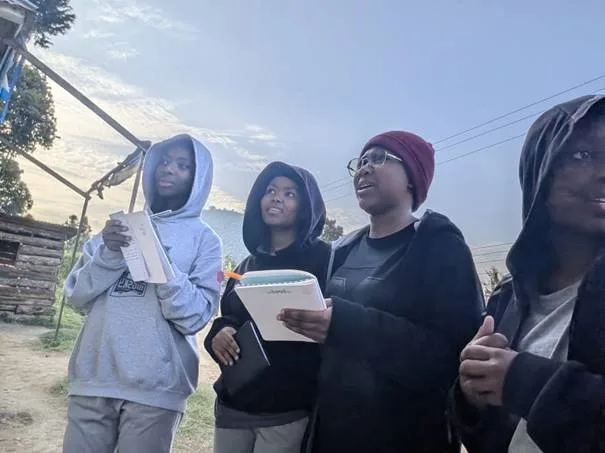
The student Knowledge Connectors during field engagement in Bangata, listening, observing and recording community perspectives.
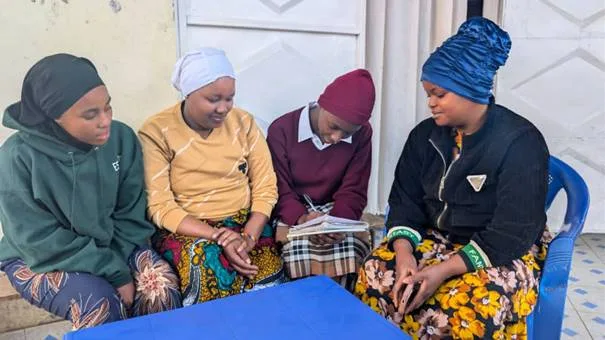
Students sit with village participants during a Bangata field conversation, recording information directly from the discussion.
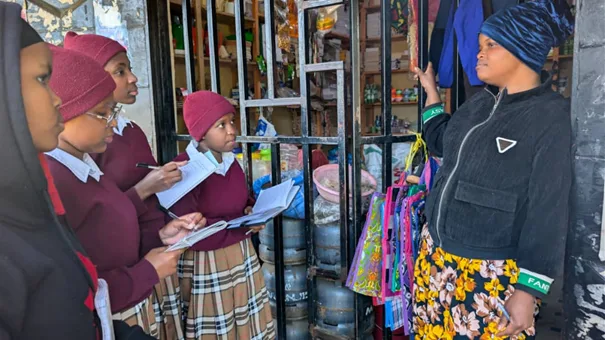
The Knowledge Connectors engage a local trader at her business, using questions and notes to understand existing knowledge, resources and constraints.
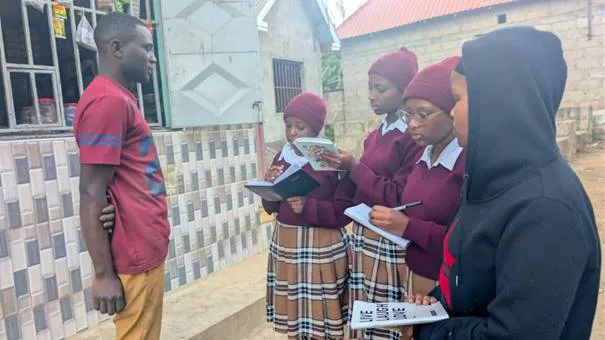
Students interview a Bangata participant and record his responses as part of the community mapping process.
Guidance, Reflection and Week 2 Kanban Evidence
The fieldwork was also supported by a cycle of reflection and guidance. The students reviewed comments and guidance from Kubair Shirazee and Team Numu and discussed how to apply that feedback with Mr Thomas Reuben of Savannah Vision Tanzania. These discussions helped the team check its method, clarify what needed to be recorded, and keep the experiment centred on evidence generated by the students and community participants.
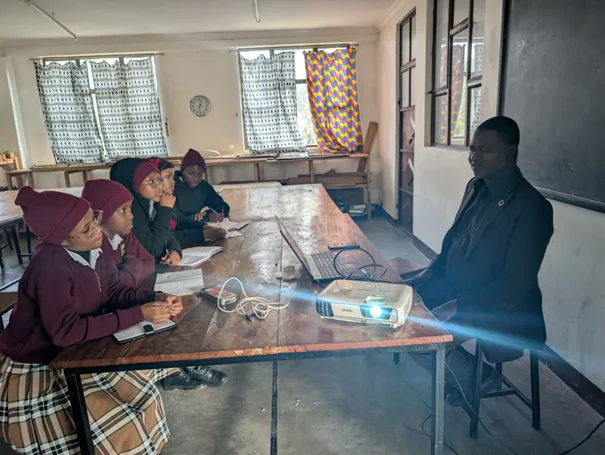
The five students discuss the experiment with Mr Thomas Reuben of Savannah Vision Tanzania, including guidance and comments from Kubair Shirazee and Team Numu.
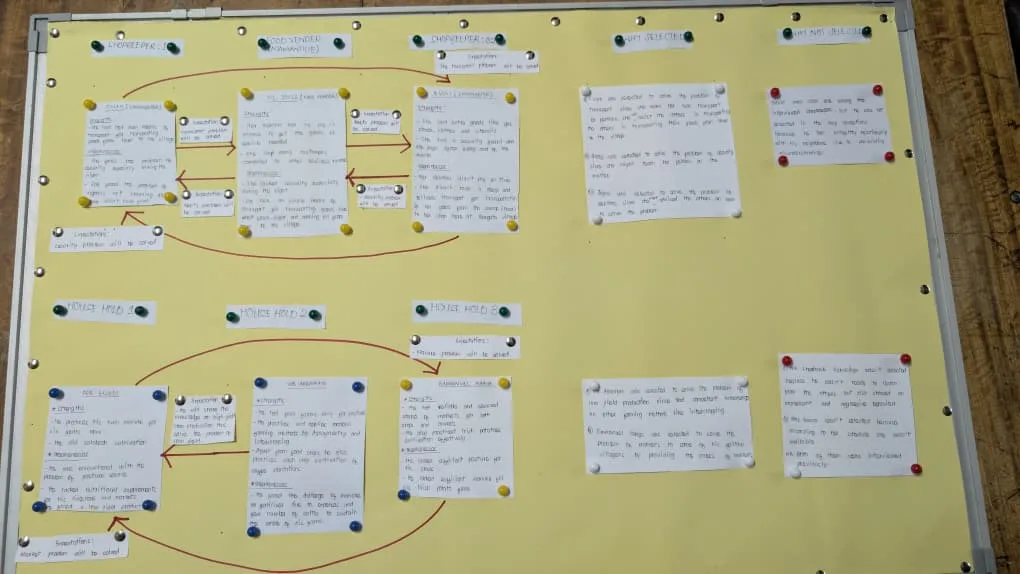
The Week 2 Kanban board provides a visual record of the experiment as it developed. It shows the students organising participant information, mapping possible connections, recording expectations and distinguishing between people selected for a connection and those not selected. The board therefore complements the later final evidence pack: it preserves part of the working process before the students returned to test what actually happened.
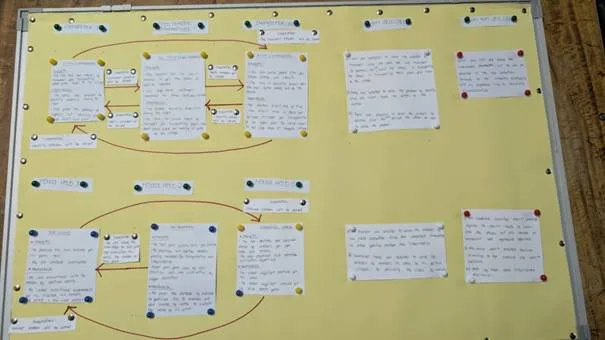
The Week 2 Kanban board records the students’ evolving map of participants, connections, expectations and selection decisions.
From 12 Respondents to Six Tested Connections
The team’s evidence trail begins with 12 respondents. From those conversations, six people were placed on the connection map. Three others were excluded from particular mapped connections, with the reasons documented rather than removed from the record.
This WHY SELECTED / WHY NOT SELECTED approach became an important part of the students’ method. It showed not only who entered the map, but also how the students made their decisions.
Traders: Connecting Experience Around Everyday Business Problems
Among the traders, the students connected Tinah, Mrs Joyce and Glory. Before following up, they wrote three predictions: the transport problem would be solved; the potato problem would be solved; and the security problem would be solved.
According to the team’s follow-up, the participants met, shared their experiences and reported that the problems identified in the three predictions were addressed through the exchange. The students’ role was not to arrive with solutions. It was to recognize potentially useful experience already present among community members, facilitate the connection, and return to ask what happened.
Farmers: From Market Access to Farming Knowledge
The agricultural side of the map connected Eliudi Kaaya, Emmanuel Obedi and Abraham around problems and experience identified during the earlier conversations. The students recorded another three predictions: the market problem would be solved; the manure problem would be solved; and a farming method would be shared.
The students report that the participants met, exchanged experience and reported that the expected problems were addressed. For the sixth prediction, the anticipated farming experience and method were shared.
One follow-up provided a concrete example of the difference between learning and doing: Emmanuel Obedi reported changing the pasture provided to his cattle and subsequently observing an improvement in milk production. The students did not independently measure milk production, so this remains a participant-reported observation rather than a measured impact claim.
The Six Predictions the Students Tested
| Prediction | People connected | Follow-up reported by the team |
| Transport problem will be solved | Tinah, Mrs Joyce & Glory | They met, shared experience and reported the problem addressed. |
| Potato problem will be solved | Tinah, Mrs Joyce & Glory | They met, shared experience and reported the problem addressed. |
| Security problem will be solved | Glory, Mrs Joyce & Tinah | They met, shared experience and reported the problem addressed. |
| Market problem will be solved | Eliudi Kaaya & Emmanuel Obedi | They met, shared experience and reported the problem addressed. |
| Manure problem will be solved | Eliudi Kaaya & Emmanuel Obedi | They met, shared experience and reported the problem addressed. |
| Farming method will be shared | Abraham & Eliudi Kaaya | They met and shared farming experience/method as expected. |
These are follow-up findings reported through the students’ fieldwork and participant responses, not a controlled impact evaluation. No baseline was taken at the beginning of the experiment, and the team has not attempted to create one retrospectively.
What Did Not Work Was Kept in the Story
The final story is not six positive results presented without context. The students’ selection and exclusion records show that not everybody interviewed became part of the connection map. Earlier in the experiment, a planned connection involving one participant could not proceed because of difficulties in the relationship with neighboring businesspeople. The team recorded that result rather than removing it.
During later fieldwork, the students also recorded difficulty collecting some audio/data when nearby people would not reduce the noise. Their own learning from this included patience and effective communication. They were also preparing for examinations, creating a practical time constraint.
These details matter because the experiment was not designed to prove that every connection works easily. Sometimes a connection succeeds; sometimes it cannot be made; sometimes change takes longer than expected. Each result is part of the evidence.
TZS 0: What Did the Experiment Cost?
The students recorded TZS 0 in direct cash expenditure for the experiment. With 12 respondents, the recorded direct experiment cost per respondent was therefore TZS 0.
This does not mean the experiment required no support. Sakura Girls Secondary School provided the setting and permission for the students to participate, while Savannah Vision Tanzania provided local introduction, guidance and oversight. Mr Reuben served as coordinator. The TZS 0 figure means something narrower and more useful: the students recorded no direct cash expenditure for carrying out the experiment.
Five Students, Five Responsibilities, Five Voices
Each student had a defined responsibility and prepared a handwritten personal reflection. Parent/guardian permission for public naming has been confirmed. Their words below are intentionally preserved as student reflections rather than rewritten into institutional language.
Lidya E. Lebayo, 17 — Team Leader
| Role in the team: Leads the team, coordinates activities and delegates duties among team members. Parent/guardian permission for public naming: Confirmed |
“Success isn’t final, failure isn’t fatal; it is the courage to continue that counts. Connecting ideas and acting as a switch board to the Bangata villagers was one of the main ideas that arose a thousand of solutions and lessons, making my community and team unstoppable.”
Lidya E. Lebayo
Joyness J. Ritton, 16 — Data Analyst
| Role in the team: Collects results, analyses findings, and leads preparation of the final report and presentation. Parent/guardian permission for public naming: Confirmed |
“Can student facilitators strengthen community development as trusted knowledge connectors? This may challenge many youths to participate and accept what they can really achieve. Well, here is an answer. Connecting knowledge and exchange of skills in my own village has helped in increasing competence and learning to develop stronger relationships by acting as helping blocks to build sustainable development.”
Joyness J. Ritton
Naomi Charles, 16 — Documenter
| Role in the team: Takes notes, records observations and keeps track of important details from the team’s fieldwork. Parent/guardian permission for public naming: Confirmed |
“What surprised me the most is that, the local knowledge connects different ideas, helps in generating lessons, opportunities and hold stronger relationship, understanding the fact that old is gold in relation for the future generation on agriculture.”
Naomi Charles
Nancy B. Mrosso, 17 — Materials Manager
| Role in the team: Prepares, organizes and distributes the equipment and resources needed by the team. Parent/guardian permission for public naming: Confirmed |
“I have learnt that the tongue may be 3 inches long but it can kill a man 6 feet tall. Two participants (unnamed) aggressiveness and lack of cooperation towards their neighbours made them not to annex the knowledge from others.”
Nancy B. Mrosso
Queen S. Edward, 17 — Photographer & Videographer
| Role in the team: Photographs and video-records important activities and events while the team is working. Parent/guardian permission for public naming: Confirmed |
“If you would hit the mark, you would must aim a little above it. Having a field study in Bangata village has made me learn a lot through observation and interviewing. As a young researcher, I learnt a lot that I never had an idea before. This has also helped me to acquire different skills and confidence, as skills and confidence are conquered aims.”
Queen S. Edward
From a Map on the Wall to Evidence in the Field
LISTEN → MAP → SELECT → CONNECT → PREDICT → RETURN → TEST → LEARN
At the beginning, the students were asking people questions. By Week 3, they were drawing connections between what different people knew and needed. By Week 4, they were returning to those same people and asking whether the lines drawn on their map had become real exchanges.
The underlying evidence includes handwritten records, consent documentation, confirmed headcounts, selection and exclusion records, the connection map, six original prediction cards, follow-up responses, photographs, video and the students’ personal reflections. The final evidence pack also records that names, quotations, photographs and video were checked against consent before public use.
What Bangata Taught the Students
The final fieldwork left the team with lessons that could not have been learned from a classroom exercise alone. Useful knowledge may already exist within a community. A person experiencing a problem may live close to somebody who has dealt with something similar. But proximity is not enough: trust, communication and willingness to participate matter.
And making an introduction is not the same as demonstrating a result. The students learned to return and ask.
What the Team Would Keep, Change and Avoid
In their final reflection, the students said Bangata should keep agricultural activities rooted in cooperation, strengthen effective communication when solving problems, and avoid unhealthy relationships that prevent people from learning from one another. Their most important lesson was simple: community problems can sometimes be addressed through the exchange of knowledge already present among neighbours.
From Fieldwork to Final Evidence and Showcase
Fieldwork closed on 24 August 2026. From 25–31 August, the five students move from fieldwork to evidence review, final documentation and rehearsal. Their final programme pack brings together the confirmed headcount of 12 respondents, follow-up evidence from six mapped participants, direct cost per participant, what did not work, and a one-page recipe another team could use to reproduce the approach.
The students will also prepare for a ten-minute showcase in which all five will speak. The final story will therefore be theirs to tell, supported by the records they created and the consent they obtained.
About the Initiative
Bangata Knowledge Connectors is undertaken by five students from Sakura Girls Secondary School in Bangata Village, Arusha DC. Sakura Girls Secondary School is the school-based partner through which the students participate. Savannah Vision Tanzania (SVTa) introduced and guided the students into the project and supported local coordination and discussion, while the students themselves carried out the listening, mapping, introductions, follow-up and evidence recording. The experiment forms part of the 2026 Grassroots Internships, a ChangeCraft initiative designed by Kubair Shirazee in partnership with Peace Through Prosperity.
Continue the Bangata Knowledge Connectors Journey
- Previous report: From Community Mapping to Knowledge Exchange
- Opening report: Five Girls, One Village, and a Shared Journey
- 2026 Grassroots Internships
- The Grassroots Playbook
- Kubair Shirazee
- ChangeCraft on LinkedIn
- Peace Through Prosperity
Tags: #BangataKnowledgeConnectors #GrassrootsInternships #TeamNumu #KubairShirazee #PeaceThroughProsperity #ChangeCraft #SavannahVisionTanzania #SakuraGirlsSecondarySchool #YouthLeadership #GirlsLeadership #CommunityKnowledge #KnowledgeExchange #ExperientialLearning #Arusha #Tanzania
Acknowledgements
Acknowledgements
Savannah Vision Tanzania gratefully acknowledges Change Craft, in partnership with Peace Through Prosperity, for creating and supporting the 2026 Grassroots Playbook Internship, which gave teams around the world the opportunity to test grassroots change through practical community experiments.
We extend special appreciation to Kubair Shirazee and Team Numu for their guidance, thoughtful feedback and continued support throughout the Bangata Knowledge Connectors experiment.
We also thank Sakura Girls Secondary School, Bangata Village leadership, participating community members, parents and guardians for enabling the students to learn directly with and from their community.
Above all, we recognize the five Bangata Knowledge Connectors whose fieldwork, conversations, mapping and documented evidence brought the experiment to life. Their work is at the heart of this update.